Short Answer: How far you can drive on a spare depends on which type your vehicle carries. A compact spare — commonly called a donut — is for emergency use only; the maximum speed and distance is set by the manufacturer and printed on the spare’s label or in your owner’s manual. A matching full-size spare carries no standard distance or speed restrictions. This guide is for Ontario drivers who have had a flat and want to know how to use their spare safely, how each type affects the vehicle, and when to get the original flat repaired.
Key Takeaways
- A compact (donut) spare is for emergencies only — the speed and distance limit is on the spare’s label and in your owner’s manual; it varies by vehicle
- A matching full-size spare carries no speed or distance restrictions and can be driven normally
- Donut spares provide less traction and stability than standard tires — avoid highway speeds
- On AWD vehicles, a compact spare’s different diameter can stress the drivetrain
- Spare tires lose air pressure over time — include the spare in monthly pressure checks
- After fitting any spare, call Fix My Tires to have the original flat repaired at your location — no need to drive on the donut longer than necessary
- Compact spares should not be rotated into the regular tire set
What Is a Spare Tire?
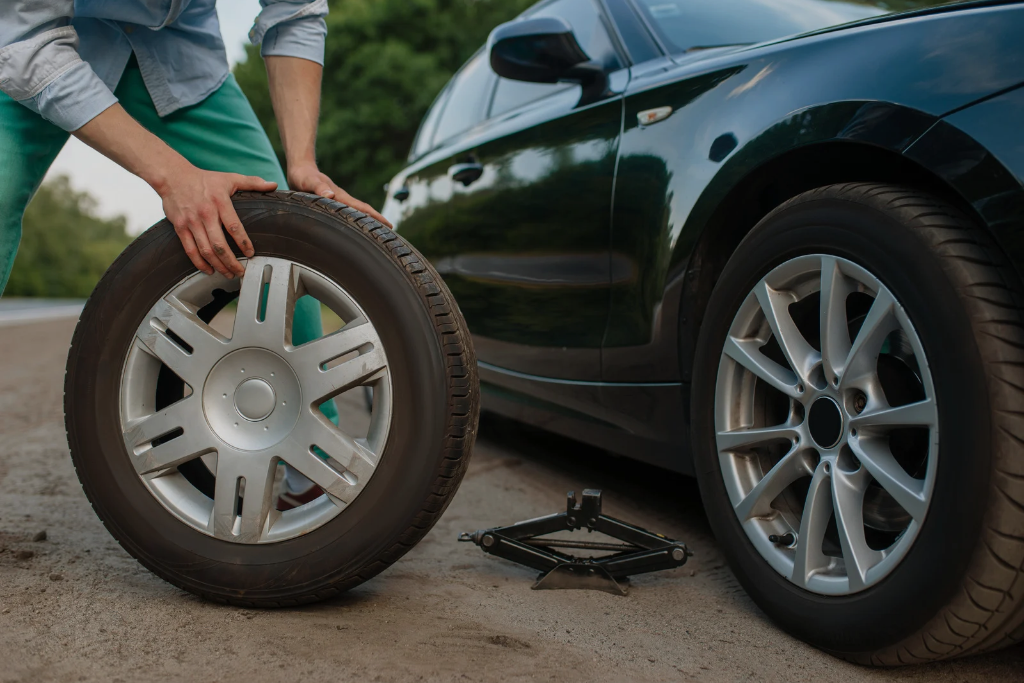
A spare tire is an extra tire kept in a vehicle for emergencies — a flat tire, a blowout, or a tire damaged beyond use. Most passenger vehicles in Canada come equipped with one spare, though the type and location vary by make and model. Spare tires lose air pressure over time and should be checked regularly, not just when you need them. Including the spare in a monthly pressure check takes less than a minute.
Types of Spare Tires
Compact Spare (Donut Tire)
A compact spare — also called a donut tire or donut spare — is smaller and narrower than the standard tires on the vehicle. Compact spare tires are lighter and take up less trunk space, which is why most modern passenger cars use them. They are designed for temporary use only and come with manufacturer-imposed speed and distance limits. A donut spare provides less traction and stability than a standard tire because of its narrower width and reduced tread contact.
Some compact spares are labelled T-type — the “T” standing for temporary — which indicates they are not suitable for extended use.
Full-Size Spare
A full-size spare matches the dimensions of the vehicle’s standard tires and can be driven at normal speeds without the restrictions that apply to compact spares. A matching full-size spare — same size, brand, and tread pattern — can be rotated into the regular tire set. A non-matching full-size spare should be treated as temporary and replaced with a matching tire when practical.
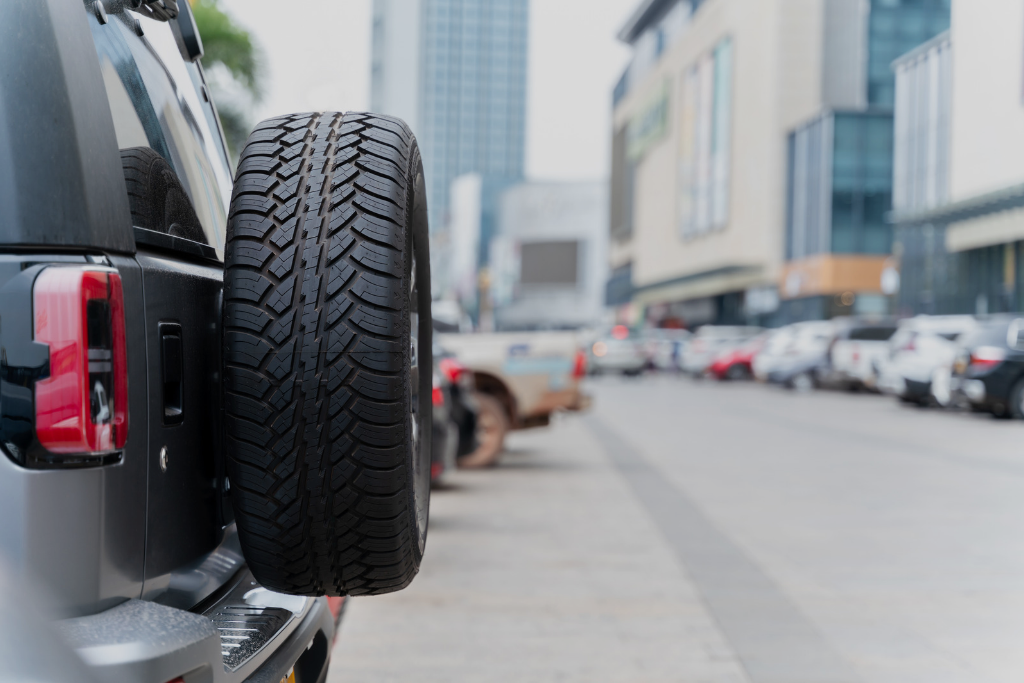
Full-size spares take up more trunk space. External spare tire mounts on SUVs and off-road vehicles store the full-size spare outside the cargo area to save interior space, though spares stored externally get dirty and can complicate a roadside change.
How Far Can You Drive on a Donut Spare Tire?
Most manufacturers recommend driving no more than 80–110 km on a compact spare. This range comes from the commonly cited figure of 50 to 70 miles. The exact limit depends on the vehicle and the spare itself — check the label on the spare tire or the owner’s manual for the figure that applies to your car.
Compact spares are built with minimal tread, lighter construction, and a narrower profile than standard tires. They are not designed to absorb the stress of regular driving over long distances. Using a donut spare beyond its recommended distance increases the risk of failure and places the vehicle’s handling in a compromised state for longer than the tire was built to sustain.
In the GTA, 80–110 km is enough to reach a tire shop from most of Mississauga, Toronto, or Brampton. If you are further out — Oshawa or Whitby — call a mobile tire service rather than driving the full distance on a compact spare.
Donut Spare Tires and High Speeds
Compact spares are not rated for highway speeds. Most manufacturers set a maximum of 80 km/h for a donut spare — roughly the speed of arterial roads, not 400-series highways. Driving a compact spare at high speeds risks overheating the tire and significantly reduces handling response.
Keep the vehicle off the highway where possible when a compact spare is fitted. If highway driving cannot be avoided, stay in the right lane, drive at 80 km/h or below, and exit at the first opportunity to have the flat repaired or replaced.
Driving on a Full-Size Spare Over Long Distances
A full-size spare that matches the vehicle’s standard tires can be driven at normal speeds for long distances without restriction. In practice, any spare should be treated as temporary — have the flat assessed and repaired or replaced as soon as reasonably possible, even when a full-size spare is fitted.
Compact spares should not be rotated into the regular tire set — their different size is incompatible with the standard rotation schedule. A matching full-size spare can be rotated in if it has comparable tread depth and condition.
How a Compact Spare Affects Your Vehicle
Fitting a compact spare changes more than just speed and distance limits.
Stability and handling. The smaller diameter and narrower width of a donut spare alters how the vehicle sits and steers. Expect reduced cornering grip and longer stopping distances compared to a standard tire.
AWD and four-wheel drive vehicles. On AWD or four-wheel drive vehicles, a compact spare’s different diameter creates a speed mismatch the differential must compensate for on every rotation. Driving on a compact spare for an extended period can affect vehicle stability and stress the drivetrain on AWD models. Check the owner’s manual — some manufacturers impose stricter limits for AWD vehicles.
TPMS. Most spare tires do not carry a pressure sensor. After fitting the spare, the TPMS warning light may remain on. This is expected — it does not indicate a problem with the spare, only that the system has lost a sensor reading from the replaced wheel.
Where Spare Tires Are Stored
Spare tires are typically stored in one of three locations depending on the vehicle:
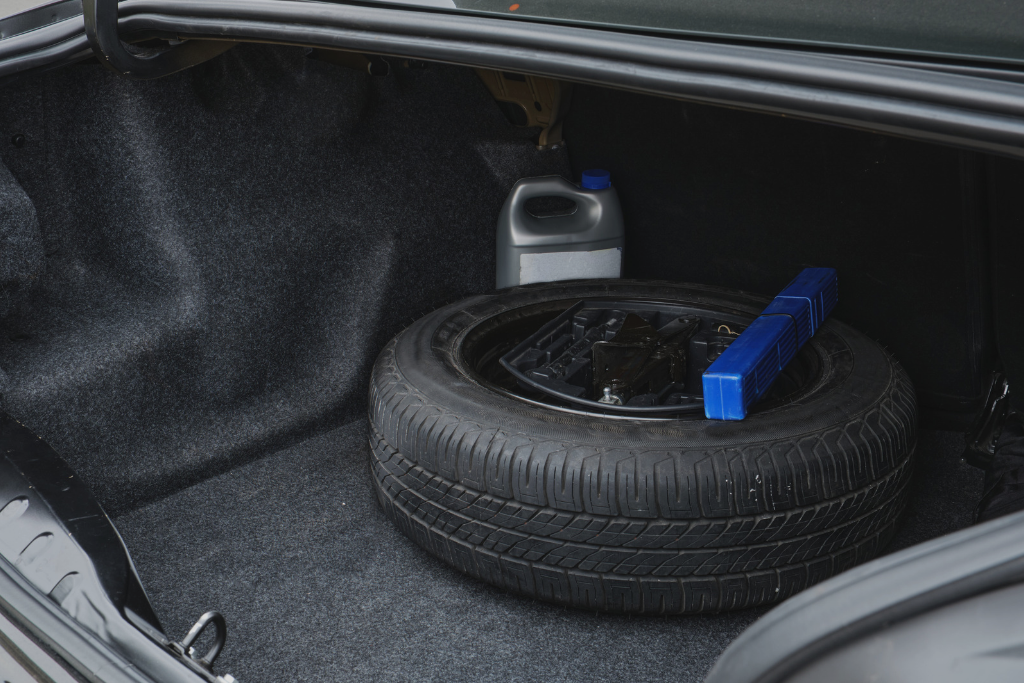
Recessed trunk compartment. Spare tires are often stored in a recessed trunk area beneath the cargo floor, in a dedicated well with a cover. This is the most common setup in passenger sedans and hatchbacks.
Under the vehicle. Pickup trucks and some larger SUVs store spare tires underneath the rear of the vehicle on a cable and lowering mechanism. Spare tires stored this way can be secured with a bolt and wing-nut fastener on some designs.
External rear mount. External spare tire mounts are common on SUVs and off-road vehicles, saving trunk space but exposing the spare to weather and road debris.
How to Change a Flat Tire Safely
Pull completely off the road onto a level, stable surface and switch on the hazard lights before getting out.
A jack must be used at the vehicle’s designated jacking points — marked in the owner’s manual. Using the wrong point can damage the body or cause the jack to slip.
Loosen the lug nuts before raising the vehicle. Once the spare is mounted, tighten them in a star pattern to apply even pressure. Recheck torque after a short drive — lug nuts can settle once the wheel is under load.
When to Get a Replacement Tire
A spare buys time — it does not replace the flat. After fitting the spare, take the vehicle to a tire shop to have the flat assessed. A tread puncture under approximately 6mm in the centre tread area can often be repaired with a patch-plug. Sidewall damage, large holes, or a tire driven flat require full replacement.
For a full breakdown of what can and cannot be repaired, see what does it mean when a tire is plugged.
Replacement passenger tires in Ontario typically range from $100–$200 or more per tire depending on size, brand, and season, with installation and balancing adding $20–$40 per tire at most shops.
Frequently Asked Questions
How far can you drive on a spare tire?
For a compact (donut) spare, most manufacturers recommend a maximum of 80–110 km. For a matching full-size spare, there is no standard distance restriction. Check the label on the spare or the vehicle owner’s manual for the specific limit applicable to your vehicle.
Can you drive a donut spare tire at high speeds?
No. Compact spares are rated for a maximum of approximately 80 km/h. Driving a donut spare at high speeds risks overheating the tire and reduces handling response. Stay off the highway where possible, and replace the flat as soon as you can reach a tire shop.
What is the difference between a donut spare and a full-size tire?
A donut spare is smaller, narrower, and lighter than a full-size tire, designed for temporary emergency use with speed and distance restrictions. A full-size spare matches the vehicle’s standard tire dimensions and can be driven without those restrictions, though it takes up more trunk space.
Is a donut tire safe for long distances?
No. Compact spares are not designed for long-distance driving. The limit of 80–110 km exists because donut tires have a lighter construction, minimal tread, and a different diameter than standard tires. Exceeding the recommended distance risks tire failure and places the vehicle’s handling under unnecessary stress.
When do I need a replacement tire instead of a repair?
A tire needs replacing rather than repairing when the puncture is in the sidewall or shoulder, the hole exceeds 6mm, the tire has been driven flat, or visible cords are exposed. If the flat can be repaired, a proper patch-plug from a tire shop is the correct fix. See flat tire repair cost in Ontario for a full breakdown of repair versus replacement costs.
Can a full-size spare be used as a regular tire?
A matching full-size spare — same size, brand, and tread pattern as the other four tires — can be used as a regular tire and rotated into the set. A non-matching full-size spare (different brand or tread depth) should be treated as temporary and replaced with a properly matched tire when practical.
Book Mobile Tire Repair With Fix My Tires
If you are driving on a spare in Mississauga, Toronto, Brampton, Oshawa, or Whitby, Fix My Tires offers mobile tire service that comes to your location to repair or replace the flat — so you are not driving further on a donut than necessary.
Call (289) 401-8473 to book.