A plugged tire is one where a rubber insert has been used to seal a puncture hole. The plug fills the channel left by a nail or screw and stops air from escaping. There are two types of plug repair — a rope plug inserted from outside the tire, and a combination patch-plug that takes the tire off the rim and seals it from the inside. These methods are not interchangeable: one is a temporary fix, the other is the industry standard for a permanent repair. This guide is for Ontario drivers who want to understand what a tire shop has done or is recommending, whether a plugged tire is safe to drive on, and when a plug is enough versus when the tire needs replacing.
Key Takeaways
- A tire plug seals a puncture channel from the outside without removing the tire from the rim
- Standalone rope plugs are classified as temporary or emergency fixes by industry standards — not permanent repairs
- A combination patch-plug, where the tire comes off the rim and the inner liner is sealed from the inside, is the industry standard for a permanent tire repair
- Plugging is only safe for punctures in the central tread area, under approximately 6mm (1/4 inch) in diameter
- Sidewall and shoulder damage cannot be safely plugged or repaired — the tire must be replaced
- Warning signs of a failing plug include visible bulges, air loss that returns, or a persistent slow leak at the same location
- A tire showing cracks or exposed cords needs replacement, regardless of where the puncture is located
- A plugged tire that has not been inspected from the inside should be treated as temporary until a technician confirms the inner liner is intact
What Is a Tire Plug?
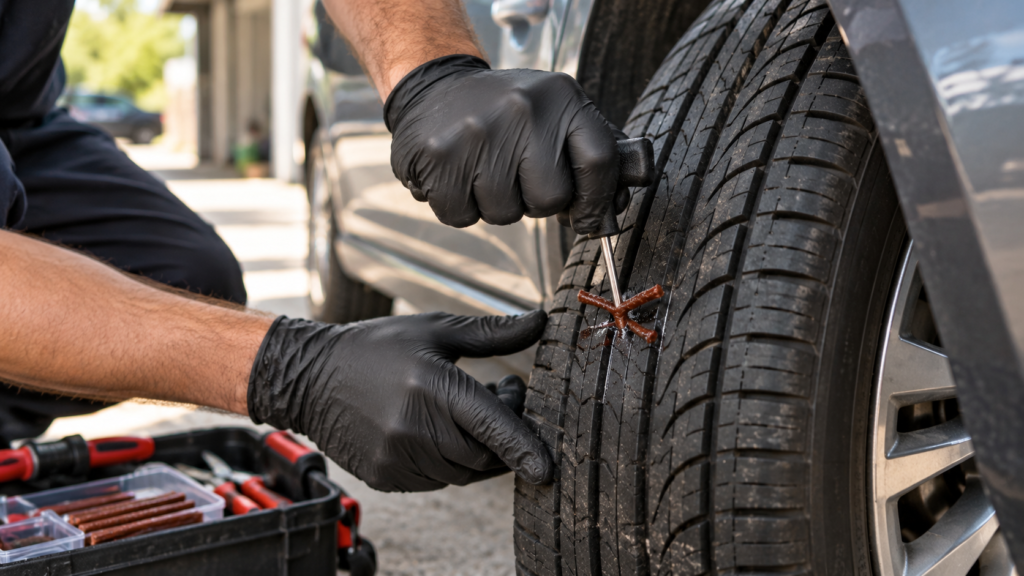
A tire plug is a rubber or rubber-and-cord insert used to seal a puncture hole in the tread. When a nail, screw, or sharp piece of road debris penetrates the tread, it leaves a channel through the rubber layers and into the air chamber. A plug fills that channel and seals it against further air loss.
There are two distinct types of plug repair, and the difference matters for safety and how long the repair lasts.
A rope plug — also called a string plug or stem plug — is pushed into the puncture channel from the outside of the tire using an insertion tool. The tire stays on the rim during the repair. Rope plugs are what most roadside tire repair kits use, and many quick-repair shops offer this as a fast, lower-cost option.
A combination patch-plug, also called a mushroom repair, is a two-part repair. The tire comes off the wheel entirely. A technician inspects the inner liner for damage before doing anything else. The puncture channel is filled from the tread side, and a patch bonds to the inner liner from the inside, sealing it against air loss and moisture. Mushroom-style repairs require tire removal for proper installation — they cannot be completed with the tire on the rim.
Both stop air from escaping. Only one addresses the inner liner.
How Does a Tire Get Plugged?
Rope Plug — Roadside or Quick Repair
The technician or driver uses a reamer tool to clean and roughen the puncture channel, then pushes a rope-style plug through the hole using an insertion tool. The plug is trimmed flush with the tread once seated. The tire stays on the rim throughout.
Most tire repair kits use rope-style plugs. A basic kit includes a reamer, an insertion tool, and a set of rope plugs. More complete kits add rubber cement, extra plugs, and a valve stem tool. The kit is compact enough to store in a trunk and a reasonable emergency item for any vehicle.
The limitation of a rope plug is that the inner liner is never examined. Hidden structural damage — a weakened belt, a separated layer, moisture that has entered the puncture channel — is invisible from outside and goes undetected. Industry repair standards, including those published by the US Tire Manufacturers Association (USTMA) and the Tire Industry Association (TIA), classify standalone rope plugs as temporary emergency fixes, not permanent repairs.
Combination Patch-Plug — Permanent Repair
A combination patch-plug begins with removing the tire from the wheel. Once off the rim, the technician inspects the full inner liner for damage. The puncture channel is cleaned and filled with a rubber stem from the tread side, and a patch bonds to the inner liner from the inside, sealing both surfaces.
A properly completed patch-plug allows the tire to serve the rest of its normal service life. It is the correct repair for any passenger car, truck, or SUV where the driver plans to keep the tire in service beyond an immediate emergency.
When Can a Tire Be Plugged?
Not every puncture qualifies for a repair. Three conditions must all be met:
Location. The puncture must be in the central tread area. Punctures must be located strictly within this zone — the repairable area covers the centre of the tread, away from the shoulder and sidewall. Anything closer to the shoulder or in the sidewall is not safely repairable by any method.
Size. Most punctures smaller than 1/4 inch — approximately 6mm — in diameter can be repaired. A puncture larger than 1/4 inch typically requires tire replacement, as the hole is too large for a plug or patch to seal reliably.
Condition of the inner liner. The liner must be intact. A tire that has been driven flat, or one showing separation or discolouration on the inner surface, may have damage that makes a repair unsafe regardless of how the puncture looks from outside.
When a Tire Cannot Be Plugged
Sidewall or shoulder damage. The sidewall flexes under the vehicle’s load on every rotation, and the shoulder concentrates stress during cornering. A plug cannot hold in either location. Sidewall and shoulder damage cannot be safely repaired under any method — rope plug or patch-plug. The tire must be replaced.
Large punctures. A hole larger than 6mm has removed too much rubber for a reliable seal. Attempting to plug it is not a safe repair.
Driven flat. Driving on a flat tire — even for a short distance — generates heat and sidewall stress that can break internal cords and separate belt layers. Driving on a flat tire can cause irreparable damage to the tire’s internal structure. A puncture that would have been straightforward to repair may not qualify once the inner liner is inspected.
Exposed cords or cracks. Visible damage such as cracks or exposed cords indicates the tire needs replacement, not a repair.
Prior repair at the same location. A tire already repaired at or near the same spot cannot be safely repaired again in that area.
Is a Plugged Tire Safe?
It depends on which type of plug repair was completed and whether the inner liner was inspected.
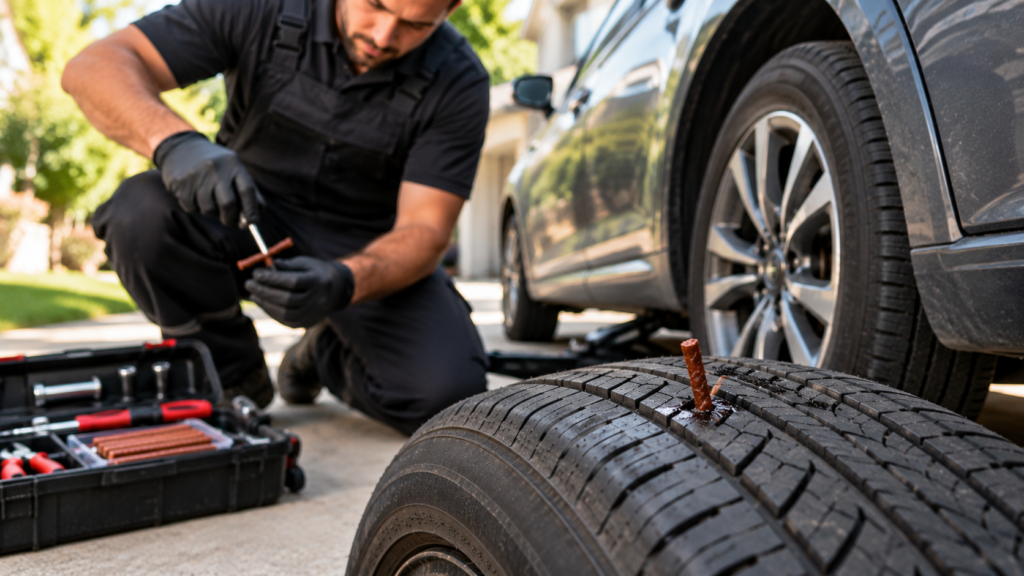
A standalone rope plug is a temporary fix. It stops immediate air loss and allows a driver to reach a tire shop rather than being stranded on the road. But a standalone plug alone does not seal the inner liner and can allow moisture to enter the tire structure over time. A tire on which a rope plug has been installed should be taken to a shop for a proper patch-plug at the first opportunity.
A properly completed combination patch-plug — where the inner liner has been inspected and sealed from the inside — is safe for the tire’s remaining service life. A patched tire that has been correctly repaired can last as long as its normal serviceable life.
Warning signs that a plug has not held: a slow leak that returns, a visible bulge near the plug site, a plug that has shifted or partially backed out, or a TPMS warning light that reappears within days of the repair.
Tire Plug vs Patch: What’s the Difference?
A plug fills a puncture channel. A patch bonds to the inner liner. Neither alone meets the industry standard for a permanent repair.
A plug alone fills the channel but does not address the inner liner surface. Over time, road vibration and temperature cycles can work a rope plug loose, and moisture can track along the plug into the tire structure. A patch alone seals the liner but leaves the puncture channel open on the tread side.
A combination patch-plug does both at once — it fills the channel and seals the liner in a single repair. It is the gold standard for a permanent tire repair and the method that industry standards recommend for returning a tire to road use.
The difference also shows up in price: a rope plug at a shop is faster and cheaper than a patch-plug, which requires the tire off the rim. For a full cost breakdown, see flat tire repair cost in Ontario.
Tire Repair Kits: What’s in Them?
Tire repair kits are available at most auto parts stores and hardware retailers. A standard kit contains rope-style plugs, a reamer to clean the puncture channel, and an insertion tool. Some kits add rubber cement, a valve core tool, and a pressure gauge. Basic kits start around $15; larger kits with additional plugs or a CO2 inflator run $25–$50.
Tire repair kits are for roadside emergencies — use the kit to reach a tire shop, not as a substitute for a proper repair.
Liquid sealant products are a short-term alternative for a slow leak. They coat the inner surface to seal small punctures but contaminate the liner and must be cleaned out before a technician can complete a proper patch-plug.
Slow Leaks and Tire Plugs
A slow leak is often caused by a small puncture partially blocked by the object still lodged in the tread. If you find a nail or screw in the tread and the tire still holds air, do not pull it out roadside — drive directly to a tire shop and let a technician assess it with the object in place.
A rope plug can stop a slow leak temporarily to reach a shop, but should not be left as the permanent solution. A slow leak that continues after a plug — or returns within a few days — means the inner liner has not been inspected and the seal has not held. The tire needs a proper patch-plug.
Plugged Tires and Winter Tires
The same repair standards apply to winter tires: a puncture in the central tread area, under 6mm in diameter, with an intact inner liner qualifies for a patch-plug. Sidewall and shoulder damage on a winter tire cannot be repaired — replacement is the only safe option.
Timing matters in Ontario, where many drivers swap tires in October and April. A slow leak or nail found at the changeover appointment should be assessed before the tire goes back into service. A properly patch-plugged winter tire can continue through the rest of the season. If the tire also shows sidewall cracking, see can cracked tires be repaired to assess that separately.
Warning Signs of a Failing Plug
A rope plug installed roadside and never followed up with a proper repair can fail over time.
Air loss returns. A tire that begins losing pressure again after plugging has not been properly sealed. Do not re-plug the same location — take it to a shop for a patch-plug.
Visible bulge. A bulge near the plug location indicates internal damage the plug did not address. The tire needs to come off the rim for inspection and may need replacement.
Plug movement. A rope plug that has shifted or is backing out of the tread has not bonded. This is a sign the temporary repair has run its course.
TPMS warning returns. A tire pressure warning that comes back shortly after a plug repair means the seal has not held or there is a second leak elsewhere. Both require a shop inspection.
When to Replace Instead of Plug
Replace a tire rather than attempting a repair if any of the following apply:
- The puncture is in the sidewall or shoulder
- The hole is larger than 6mm in diameter
- The tire was driven flat and internal inspection shows damaged belts or cords
- Cords are visible anywhere through cracks or punctures
- A bulge is present on the sidewall or tread
- The tread depth is at or below Ontario’s on-road legal minimum of 1.5mm (R.R.O. 1990, Reg. 625)
- A prior repair exists at or near the same location
A tire that needs replacing should not be driven on further. Driving with significantly low tire pressure can trigger a blowout, particularly at highway speeds.
How Much Does a Tire Plug Repair Cost?
A rope plug installed at a tire shop in Ontario typically costs $15–$30. This is the faster option but classified as temporary.
A combination patch-plug — where the tire comes off the rim and the liner is inspected and sealed — runs $20–$45 at a fixed shop and $75–$120 for a mobile repair service in the GTA. Mobile service includes the call-out: a technician drives to your location, removes the tire, completes a full patch-plug on-site, and remounts it — no need to drive a damaged tire to a shop. For a complete cost breakdown by repair type, see flat tire repair cost in Ontario.
Frequently Asked Questions
What does it mean when a tire is plugged?
It means a rubber insert has been used to seal a puncture hole in the tire. A rope plug is inserted from the outside without removing the tire from the rim — a fast temporary fix for emergencies. A combination patch-plug takes the tire off the rim, inspects the inner liner, and seals both the puncture channel and the liner surface from the inside. The second method is the industry standard for a permanent repair; the first is a temporary measure to reach a tire shop.
Can you drive on a flat tire to get it plugged?
No. Driving on a flat tire generates heat and lateral stress that can destroy the internal structure. A puncture that would have been repairable may require full replacement after being driven flat. If a tire goes flat, stop as soon as it is safe and call for roadside assistance or a mobile tire repair service.
What tire repair kits work for plugging a tire?
Standard kits with rope-style plugs, a reamer, and an insertion tool are suitable for a roadside emergency. They are available at most auto parts stores across Mississauga and the GTA, starting around $15. Use the kit to reach a tire shop, not as a finished repair.
Can winter tires be plugged?
Yes, under the same conditions as any other tire: the puncture must be in the central tread area, under approximately 6mm in diameter, and the inner liner must be intact. A properly completed patch-plug can return a winter tire to service for the rest of the season. Sidewall and shoulder damage on a winter tire cannot be repaired — replacement is the only safe option in those cases.
Is a plug enough to fix a slow leak?
A rope plug can stop a slow leak temporarily and allow the vehicle to reach a shop. It should not be left as the finished repair. A slow leak that continues after a plug, or returns within a few days, means the seal has not held and the inner liner has not been inspected. A tire shop should complete a full patch-plug to confirm the liner is intact.
Is a plugged tire a permanent tire repair?
A standalone rope plug is not a permanent repair — industry standards classify it as a temporary or emergency fix. A combination patch-plug, where the tire comes off the rim, the liner is inspected, and the hole is sealed from both sides, is a permanent repair that can last the remaining serviceable life of the tire.
Book Mobile Tire Repair With Fix My Tires
If you need a puncture repaired on-site — a proper patch-plug without driving a damaged tire to a shop — Fix My Tires handles mobile tire service across Mississauga, Toronto, Brampton, Oshawa, and Whitby.
Call (289) 401-8473 to book.