Put winter tires on when daytime temperatures stay consistently below 7°C — in the GTA, that is usually mid-to-late October. Ontario has no province-wide law requiring winter tires in southern Ontario, but insurers are legally required to offer a discount to drivers who install them. This guide is for Ontario passenger vehicle drivers who want the right timing, the right tire, and a clear read on what the law actually says. Getting it wrong means driving on hardened all-season rubber before the first snow arrives.
Key Takeaways
- Switch when temperatures consistently fall below 7°C — GTA drivers typically hit this in mid-to-late October
- Ontario has no winter tire law for southern Ontario; an insurance discount is mandatory, but the law sets no specific percentage
- The Three-Peak Mountain Snowflake symbol is the correct marking; M+S alone is not enough
- Install all four tires — not just two
- Winter tires with tread near 4mm have lost most of their grip on snow; Ontario’s on-road legal minimum is 1.5mm
- Studded tires require a Northern Ontario resident owner permit; permitted September 1–May 31 under Reg. 625
- Remove winter tires when temperatures consistently rise above 7°C in spring
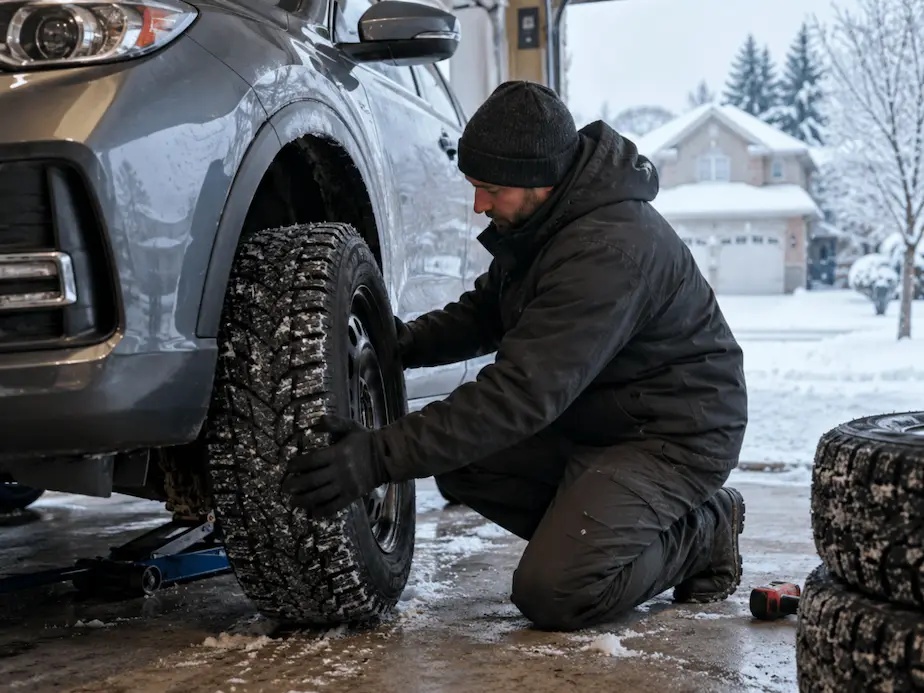
Cold weather arrives before the first snowfall, and so should your winter tires. The rubber compound in all-season tires stiffens below 7°C — before a single flake hits the road — and braking distances grow. Swapping early is not overcautious. It is how the timing works.
When Should You Put On Winter Tires?
Install winter tires when daytime temperatures stay consistently below 7°C. In the GTA and southern Ontario, that is typically mid-to-late October. In northern Ontario, the cold arrives earlier — often in early October.
The trigger is temperature, not snow.
Why 7°C Is the Threshold
Winter tire compounds use a softer formulation that stays pliable in cold weather. All-season tires harden below 7°C, losing the flexibility that allows rubber to conform to road surfaces. On cold, dry pavement — before any snow — all-season tires already brake in longer distances than dedicated winter tires.
Winter tires can reduce stopping distances by up to 25% to 40% compared to all-season tires in winter conditions.
Don’t Wait for the First Snowfall
Every October, tire shops across Ontario fill up once snow hits a forecast. Waiting means booking into a backlog and driving to the appointment on cold all-seasons. Switching before the cold snap also gives winter tires time to seat properly before the hardest conditions arrive.
Is There a Winter Tire Law in Ontario?
Southern Ontario has no mandatory winter tire law. There is no province-wide requirement equivalent to Quebec, which mandates winter tires from December 1 to March 15, or British Columbia, which requires winter tires on designated highways from October 1 to April 30.
What Ontario does mandate is an insurance discount. Insurers in the province are required by law to offer a discount to drivers who install four winter tires. The law does not set a specific percentage — the amount varies by insurer.
Ontario’s Winter Tire Insurance Discount
Before installing, call your insurer to confirm the discount, the dates it applies, and whether they require documentation such as an installation receipt. Not all insurers ask for one, but some do.
Studded Tires in Northern Ontario
Studded tires are not permitted on most Ontario roads. Under R.R.O. 1990, Reg. 625, s.9(1), studs are permitted from September 1 to May 31 when the vehicle owner holds a permit and is a Northern Ontario resident — the exemption attaches to the owner, not a geographic zone. For ≤2,500 kg vehicles, maximum stud protrusion is 1.2 mm when new and 2.0 mm in use. Verify current requirements at ontario.ca/laws/regulation/900625 before purchasing.
The Mountain Snowflake Symbol
What the Mountain Snowflake Symbol Means
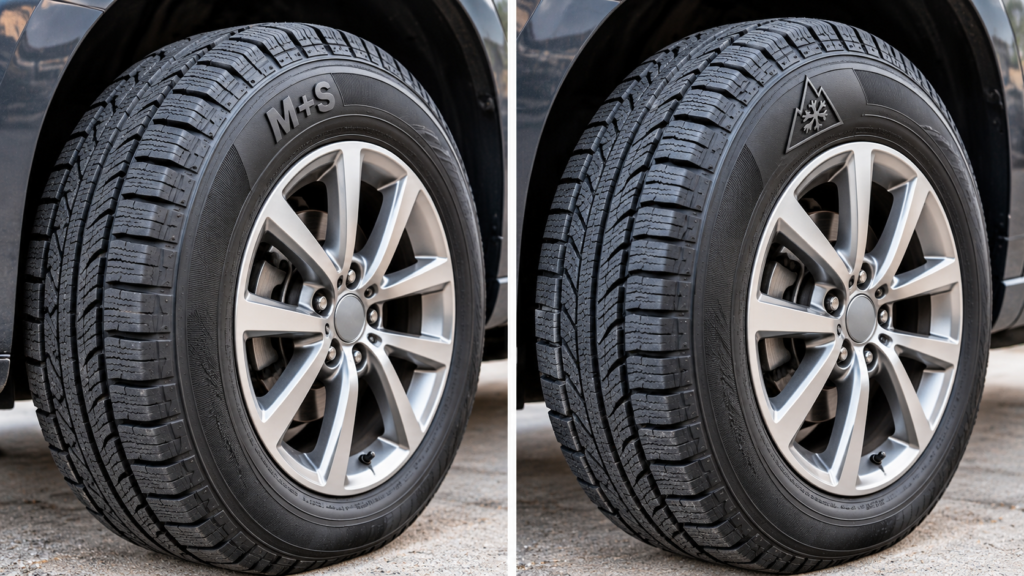
The Three-Peak Mountain Snowflake symbol — three mountain peaks with a snowflake — appears on tires tested and certified for severe snow conditions. A tire carrying this symbol has met a standardized performance threshold for traction on snow and ice.
M+S vs Mountain Snowflake Symbol
An M+S (mud and snow) marking appears on many all-season tires. It indicates a basic tread design requirement for mixed conditions — not a performance test for severe winter traction. For Ontario winters, look for the mountain snowflake symbol, not just M+S.
All-Season Tires in Winter
All-season tires handle summer driving and light autumn conditions. Below 7°C, the compound hardens and grip drops. On snow-covered roads or black ice, all-season tires stop in longer distances than dedicated winter tires. They are legal in Ontario but not designed for severe winter conditions. For a side-by-side comparison of what separates each tire category, see all-season vs all-weather vs winter tires.
Installing Winter Tires: What to Know
Install All Four Tires
Install four matching winter tires, not two. Fitting winter tires only on the drive wheels creates a grip imbalance between front and rear. In corners and under hard braking, that imbalance makes the vehicle unpredictable. Transport Canada advises a full set of four.
Speed Rating and Load Index
Each winter tire should match or exceed the speed rating and load index specified for your vehicle. Both appear on the driver’s door sticker and in the owner’s manual. Mismatching ratings across four tires affects handling and may affect warranty coverage.
Air Pressure in Cold Weather
Air pressure drops approximately 1 PSI for every 6°C fall in temperature. Check tire pressure monthly through winter and after large temperature swings. The correct inflation figure is on the driver’s door sticker — not on the tire sidewall.
Tread Depth and Winter Tires
The 4mm Threshold
Winter tires need deep, open tread channels to push slush and water away from the contact patch. As tread wears toward 4mm, grip on snow drops. Transport Canada advises replacing winter tires as depth approaches 4mm, well before Ontario’s on-road legal minimum of 1.5mm.
Tread Wear Indicators
Tread wear indicator bars sit in the tread grooves at approximately 1.6mm. When those bars are flush with the tread surface, the tire is at or near Ontario’s road minimum. For snow use, do not wait for the indicators — a winter tire approaching 4mm should come off the vehicle.
When to Remove Winter Tires
Remove winter tires when temperatures consistently rise above 7°C — in the GTA, typically April. Running winter tires through warm weather wears the soft compound faster and reduces fuel economy.
Frequently Asked Questions
When should I install winter tires in Ontario?
Install when daytime temperatures consistently drop below 7°C — mid-to-late October in the GTA, earlier in northern Ontario.
Is there a winter tire law in Ontario?
No province-wide mandate exists for southern Ontario. Insurers are legally required to offer a discount for four installed winter tires, but installation is not legally required for most drivers in the south.
Do winter tires lower insurance in Ontario?
Ontario insurers are required by law to offer a discount. The law does not set a percentage — ask your insurer for the amount and what documentation they require.
What is the mountain snowflake symbol on winter tires?
The Three-Peak Mountain Snowflake symbol means the tire has passed a standardized test for severe snow conditions — a higher standard than the M+S designation.
Can I use all season tires in winter in Ontario?
All-season tires are legal but lose grip below 7°C and are not rated for severe snow conditions. For regular Ontario winter driving, dedicated winter tires with the snowflake symbol stop shorter on snow and ice.
What are the studded tire rules in Ontario?
Studded tires are generally not permitted in Ontario. Under Reg. 625, s.9(1), studs are permitted September 1–May 31 for vehicle owners who hold a permit and are Northern Ontario residents. The exemption attaches to the owner, not a geographic zone.
What tire pressure should I use for winter tires?
Use the pressure on the driver’s door sticker or owner’s manual. Check monthly — cold air causes pressure to drop, and underinflated winter tires underperform.
What speed rating do I need for winter tires?
Match or exceed the speed rating on your driver’s door sticker. Do not mix speed ratings across the four tires on your vehicle.
Book a Mobile Winter Tire Change With Fix My Tires
Fix My Tires offers mobile winter tire change across Mississauga, Toronto, Brampton, Oshawa, and Whitby. A technician comes to your driveway or workplace to mount, balance, and install your winter set — no shop visit required.
Call (289) 401-8473 to book before October’s peak.