A flat tire is repairable if the puncture is 6mm or smaller and sits in the tread, not the sidewall. Ontario’s Ministry of Transportation advises staying inside a locked vehicle on major highways rather than changing a tire roadside. Fix My Tires covers what to do first, when repair makes sense, and why mobile tire service often beats waiting for a tow.
Key Takeaways
- Ontario law requires a minimum tire tread depth of 1.5mm to stay road-legal
- Most punctures of 6mm or smaller can be repaired if caught early
- A tire driven flat for any distance is almost never repairable afterward
- Tire rotation every 8,000 to 10,000 km helps prevent uneven wear that raises flat risk, and it pairs well with seasonal tire changes between winter tires and summer sets
- Emergency kits should include at least 7 items: gauge, spare, jack, wrench, flashlight, gloves, and roadside contact info
Before You Start
Checking a flat and deciding whether it is repairable is something most drivers can assess safely in a driveway or parking lot. It stops being a DIY situation the moment the vehicle is on a highway shoulder, in poor visibility, or next to fast-moving traffic — that is when calling for help, not attempting a roadside fix, is the safer move.
A flat tire is inconvenient on its own, but changing it in a dangerous location increases the risk significantly. Regular checkups on tire pressure and tread depth go a long way toward preventing a flat from happening at the worst possible moment in the first place. For situations that call for help right away, emergency mobile tire repair brings a certified technician to your exact location instead of asking you to work roadside.
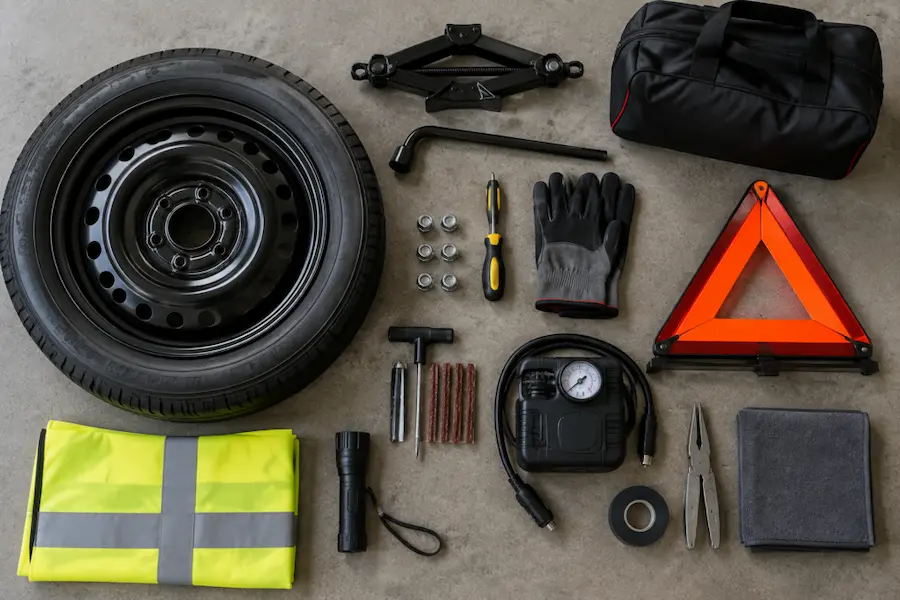
What You Need
- Tire pressure gauge
- Properly inflated spare tire
- Jack and lug wrench
- Flashlight and gloves
- Reflective triangle or hazard markers
- Roadside assistance contact information
Safety And Prerequisites
Changing a tire next to fast-moving traffic is extremely dangerous, and it is a leading cause of secondary collisions on GTA highways. If a flat develops while driving, activate hazard lights and slow down gradually rather than braking hard. Keep a firm grip on the steering wheel, since a blowout can pull the vehicle sideways. On major highways, Ontario’s Ministry of Transportation advises staying inside your locked vehicle and waiting for help rather than attempting a repair yourself.
Step-By-Step: Repairable, Replace, Or Tow
Step 1: Get To A Safe Spot
If you can still drive slowly, pull well off the road — a driveway, parking lot, or wide shoulder away from traffic. If you are on a highway and cannot move safely, stay inside the vehicle with doors locked and call for help instead of stepping out.
Step 2: Inspect The Damage
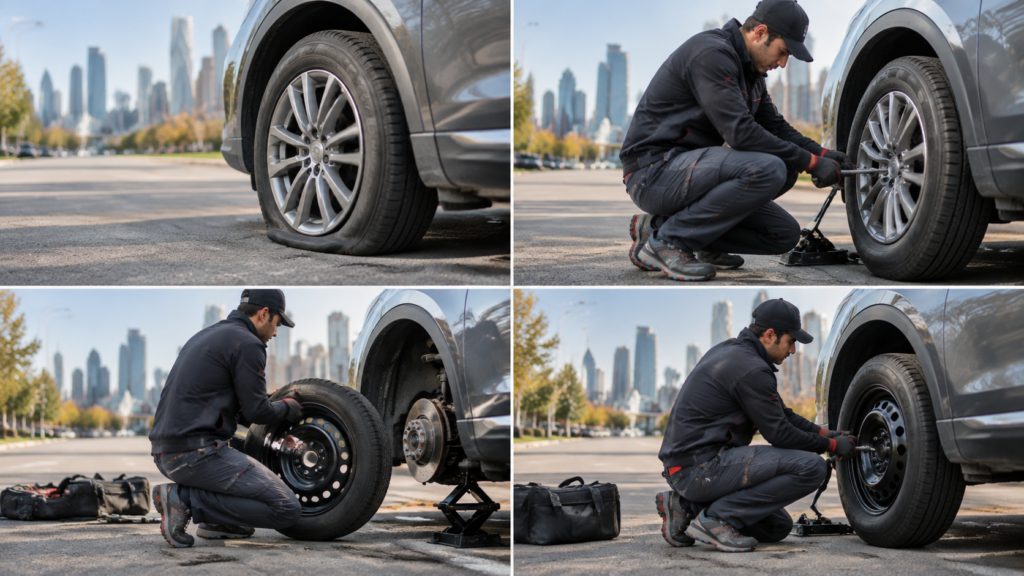
Look for the object causing the flat and note its location on the tire. A puncture in the tread, away from the sidewall, is usually repairable if it is 6mm or smaller. Sidewall damage, or a tire that has been driven any real distance while flat, is a different situation entirely.
If It Does Not Work First Time
If you cannot find visible damage but the tire is clearly losing air, it may be a slow leak rather than a single puncture.
Most Common Cause
A small nail, screw, or piece of road debris lodged in the tread that is not immediately obvious without a close inspection.
Stop Here If You See This
If the sidewall is bulging, torn, or shows structural damage, do not attempt to drive on it or repair it — the tire needs replacement, not a patch.
Step 3: Decide Repair Or Replace
A flat tire should be repaired if the puncture is 6mm or smaller and located in the tread. A tire that has been driven flat, even briefly, is almost never repairable afterward, since the rim and internal structure are often damaged beyond a simple patch. Under-inflation before the flat also matters — driving on a tire that was already low generates excess heat, raising the risk of blowouts and structural damage that rules out repair entirely.
Step 4: Get Moving Again
Once you know whether the tire needs a repair, a new tire, or a full replacement, the fastest path back on the road is usually not changing it yourself on a busy shoulder. A mobile tire service can come to your home, office, or roadside location, inspect the damage, and either patch the tire or install a new one on the spot. Learn more about our home tire repair service.
When DIY Stops Being Sensible
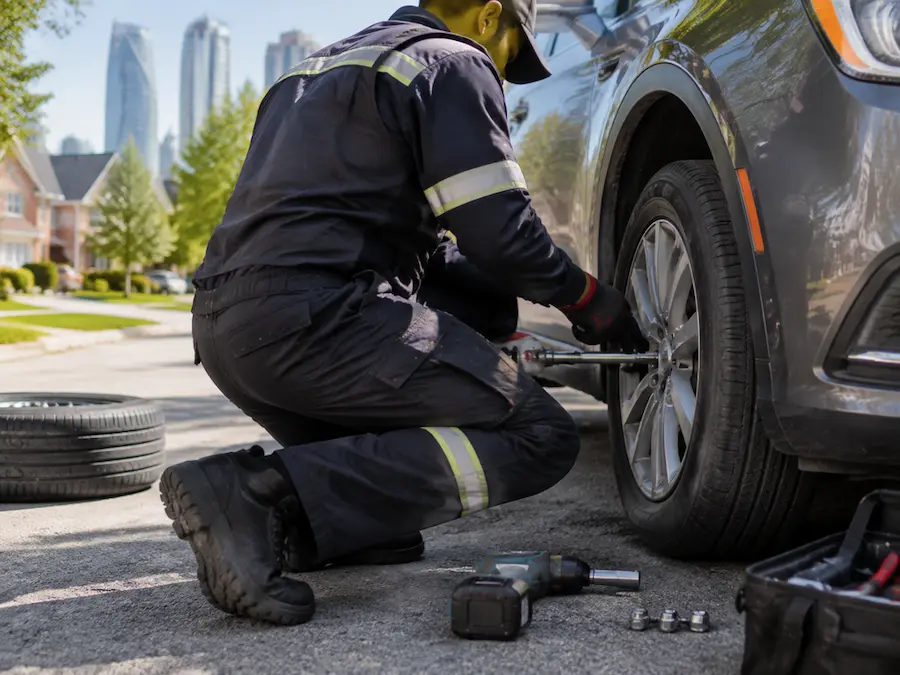
Changing your own flat makes sense in a safe, low-traffic spot with a properly inflated spare and no other vehicle issues. It stops making sense the moment you are stranded next to fast-moving traffic, in poor weather, without a safe place to pull over, or facing a puncture you are not confident inspecting yourself. At that point, calling for emergency mobile tire repair is the safer and often faster option — a certified technician comes to you instead of you driving to a tire shop or waiting on a tow.
What A Mississauga Professional Does Differently
A certified technician inspects the puncture size, location, and tread depth before recommending a fix, rather than guessing. Tire repairs typically include inspection, patching, and rebalancing, done to industry standards rather than a quick roadside plug. Experienced technicians also catch related issues — uneven wear, low tire pressure monitoring system readings, or a tire size mismatch — that a driver changing their own flat would likely miss. That level of care is the real difference between a repair that lasts and one that fails again within weeks.
The same visit is also a natural moment to check the rest of the vehicle. A technician who is already inspecting one damaged tire can flag tread wear on the others, confirm all four are the correct diameter and size for the vehicle model, and recommend a rotation if wear is uneven. That kind of thorough check rarely happens during a rushed roadside change, but it matters just as much for long-term safety and performance.
Frequently Asked Questions
What do you do immediately after getting a flat tire?
Activate hazard lights and slow down gradually rather than braking hard. If you can safely reach a driveway, parking lot, or wide shoulder, pull off there. On a highway with fast-moving traffic, staying inside your locked vehicle and calling for help is safer than attempting a roadside change yourself.
Can a flat tire be repaired, or does it always need replacing?
Most punctures can be repaired if caught early, especially if the puncture is 6mm or smaller and sits in the tread rather than the sidewall. A tire that has been driven flat for any distance, or one with sidewall damage, is almost never repairable and needs full replacement instead.
Is it safe to drive on a flat tire to reach a shop?
No. Driving on a flat tire can cause irreparable damage to the rim and the tire’s internal structure, turning a simple repair into a full replacement. Even a short distance driven flat is often enough to rule out repair entirely, so it is safer to stop and call for help.
How much does mobile tire repair typically cost compared to a tow?
Pricing varies by service and vehicle, so it is worth confirming directly with a provider before booking. What matters most is that mobile tire service often resolves the issue in one visit, without the added wait and cost of towing to a shop and back.
About Fix My Tires
Fix My Tires provides mobile tire service across Mississauga and the Greater Toronto Area, handling flat repairs, new tire sales, tire rotation, and seasonal changeovers at your location. Certified technicians bring shop-grade equipment directly to your home, office, or roadside, working on a full range of vehicles including SUVs and light trucks.
Service Area
Fix My Tires serves Mississauga, including Streetsville, Meadowvale, Erin Mills, Port Credit, Malton, and Cooksville, along with Brampton, Whitby, Oshawa, Toronto, and the wider GTA.
Next Step
If you are dealing with a flat tire right now or want a technician on standby before your next road trip, book emergency mobile tire repair and get expert care without the tow. It only takes one tire going flat at the wrong moment to make the case for having a mobile option ready — even topics like tire storage and seasonal swaps become easier once you have a technician you trust.
Call +1 (289) 401-8473 to schedule.